
What exactly is “the seat of consciousness?” I love this term! According to neuroscience this refers to the Prefrontal Cortex of the brain. It may help to see some of it’s basic functions.
- Regulating attention
- Decision Making
- Regulating emotions and showing of empathy
- Goal setting
- Self-control or Inhibitions
- Working Memory
- Prioritizing tasks
We are looking at the marvelous architecture of the human brain. While we often think we are the “pilot” of our lives, the neurobiological data suggests we are mostly the “passenger” observing a massive automated engine.
In cognitive neuroscience, the widely accepted (though simplified) estimate is that 95% of brain activity is subconscious, while only 5% is conscious.
The remaining 95% is Subconscious! This is the “Background Engine.” It handles everything from your heart rate and breathing to complex social scripts, motor patterns (driving, walking, etc.) and emotional “waves.”
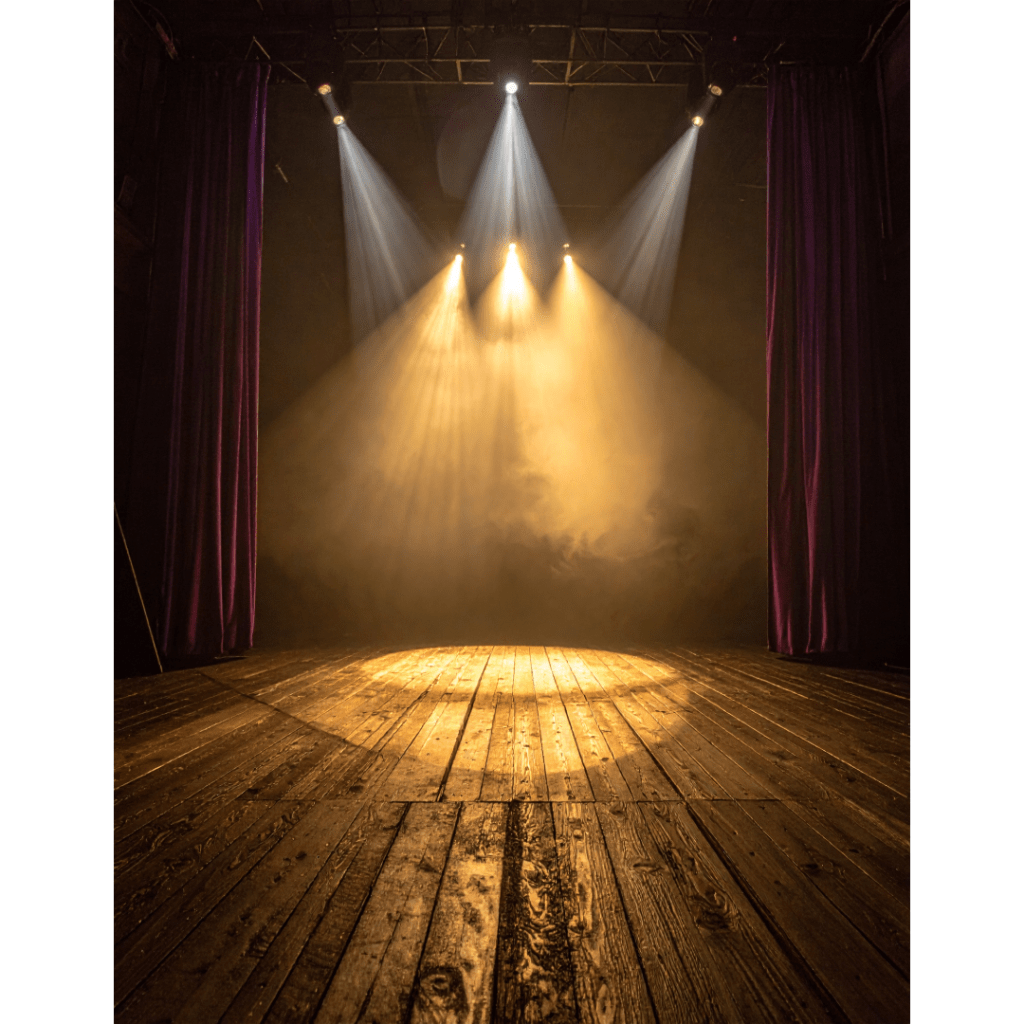
The Conscious (5%): This is the “Spotlight.” It is only active when you are learning a brand-new task, making a difficult moral choice, or using your Logic to solve a specific problem. The rest of the 95% is “in the dark.”
The “Spotlight” is the most accurate metaphor for the 5% Conscious Mind because of how the Prefrontal Cortex (PFC) manages Attention.
In a dark room (your 95% subconscious), everything is still there—the furniture, the walls, the dust—but you only “see” what the spotlight is pointed at.
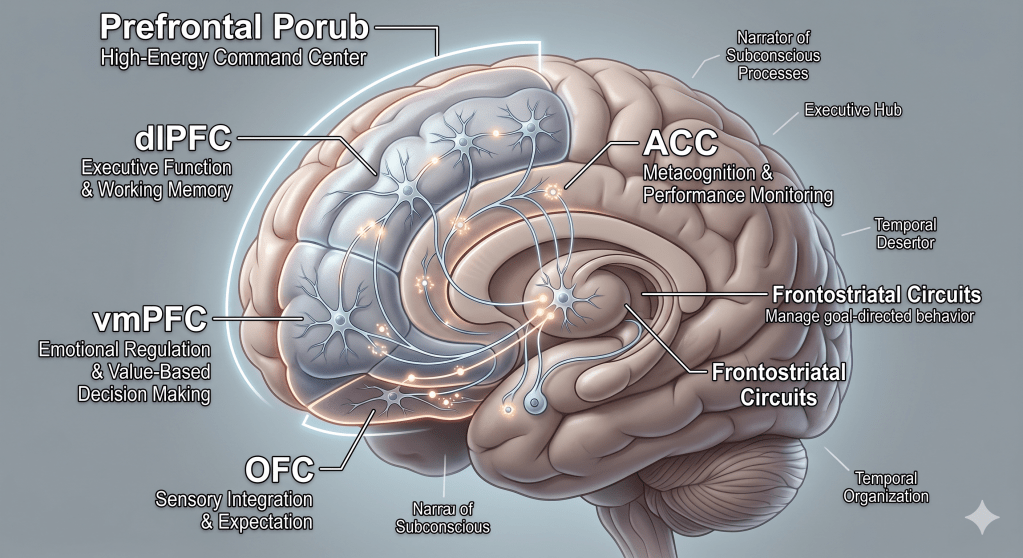
So although the PFC (Prefrontral Cortex) does not work alone, it is considered the CEO of the brain, the command and control center, or as you may call it–the seat of consciouness.
We may think we are in the driver seat with full control of our faculties. Making so many decisions day in and day out. Experientially today has been a crappy day so far. I woke up feeling like my autistic brain needed a jumpstart by a mechanic. I felt soooooo sluggish and just could not get going. I needed to get an oil change and was loathing the social contact before I even got there. The staff had great customer service but I was masking and cringing inwardly–I could not wait to get out of there! My brain was screaming RED ALERT! RED ALERT! We are currently at ZERO capacity. We are at an elevated risk for shutdown.
Alas, I survived and was happily on my way home with my earbuds in my ears. But….I forgot my greek yogurt for lunch. Crap. Made a U-turn to made the dreaded trip to Aldi’s to retrieve Greek Yogurt which is part of my lunchtime ROUTINE. If you’re autistic then you know how critical routine is for our stability.
As I was driving there I had this nudge that I needed to switch from my Powerbeat Pro headphones to different one before entering the grocery store. Mind you, I did NOT want to take off my Power Beats Pro, but at that the same time, I had this mysterious nudge to switch. So I switched to my JLAB Epic Sport ANC 3.0 which has an excellent active noise canceling feature. Then I put a music track on repeat: BANGA by HOL! You can sample the tunes below.
I did not realize how BAD my inner state had become—but my subconscious mind did. It was nudging me to protect my delicate Prefrontal Cortex and energy reserves, which were already low. When I was at the grocery store, I was in a “System-Critical” state—groggy, post-social friction, and dealing with an unexpected u-turn. Completely in an anxiety induced situation. I could only see the spotlight in front of me.
My subconscious mind was predicting it would soon embark upon an unsafe environment. I hadn’t been in this particular store in a long time. A lot of unknown variables would be there. Sensory chaos. Bright lights. Strangers. Background conversations. It was like having a good friend tell me. Hey, you need to prepare for this. Let me tell you what to do.
It said, switch headphones to protect your ears. Continue listening to Riddim, which is a specialized subgenre of dubstep, put this song on repeat. And finally continue with a recurring 15 minute countdown timer. I didn’t hear a voice, but I felt an intuitive nudge to do these things.
Here are the following benefits of those actions.

The Acoustic anchor.
The Temporal anchor.
The Acoustic Anchor: The “Sonic Handrail”
For someone with autism, the world often lacks Sensory Predictability. Most environments (like Aldi or a mechanic’s shop) are “High Entropy”—noises happen at random intervals, which forces your brain to constantly generate “Prediction Errors.”
• How it works: By playing a track like BANGA on repeat, it provided a Static Variable.
• The Benefit: Because the rhythm and frequency of the song never change, your brain stops trying to “process” the music and starts using it as a Reference Point.
• The “Handrail” Effect: Much like a blind person uses a wall to navigate a room, your brain uses the steady 140 BPM beat to navigate the store. You aren’t “listening” to music; you are using the music to “measure” your environment. It lowers the “Computational Load” on your brain because 95% of your auditory environment is now 100% predictable.
The Recurring Timer: The “Temporal Anchor”
While the music anchors your Sensory system, the 15-minute recurring timer anchors your Executive Function (PFC).
• What it is: This is a Temporal Anchor. It creates a “Pulse” in time.
• Why it benefits AuDHD: One of the hallmarks of ADHD and Autism is “Time Blindness” (Dyschronometria). In a crisis or a “groggy” state, you can lose track of how long you’ve been in a “Transition” or how much energy you’ve spent.
• The “Check-In” Signal: Every time that timer goes off, it forces your 5% Conscious Spotlight to perform a System Audit:
1. “Where am I in the sequence?”
2. “How is my battery level?”
3. “Am I hyper-focusing on the wrong variable?”
• The Benefit: It prevents the “Time Slip.” It ensures that even if you are “lost” in the social loathing or the rescue mission, you are “pulled back” to consciousness every 15 minutes to re-evaluate your sovereignty.
I was able to navigate a bunch of unknowns and avoid a potential shutdown. Whew!

 neurospicybrains