
Understanding ADHD Burnout: A Neurological System Failure
First, I had no idea that ADHD had burnout! I thought it was only related to Autism. Here’s a breakdown. ADHD Burnout is a state of chronic physical and mental exhaustion, often accompanied by a temporary loss of executive function and a significant decrease in emotional regulation. Unlike typical fatigue, it is specifically tied to the prolonged struggle of navigating a world designed for neurotypical brains using a neurodivergent operating system.
1. The Neurobiology of Normal Function vs. ADHD
To understand the burnout, we must first look at the baseline mechanics of the ADHD brain.
- The Prefrontal Cortex (PFC): This is the brain’s “Executive Command Center.” It is responsible for Inhibitory Control (stopping impulses), Working Memory (holding information), and Task Initiation (starting the engine).
- The Dopamine Pathway: Dopamine is the neurotransmitter of “Reward and Effort.” In a neurotypical brain, dopamine flows steadily, signaling that a task is worth doing. In an ADHD brain, dopamine levels are either lower or the receptors are less efficient, making it difficult to find the “spark” for mundane tasks.
- The Thalamic Gate: This acts as a filter for sensory input. In ADHD, this gate is often “leaky,” letting in too much noise, light, or tangential thought, which forces the PFC to work overtime just to keep the person on track.
2. Causes: The Road to Down-Regulation
Burnout occurs when the metabolic and psychological cost of “functioning” exceeds the brain’s ability to recover.
- Chronic Masking: The act of constantly monitoring and suppressing ADHD traits to fit into professional or social environments is a high-voltage activity. It consumes massive amounts of glucose and oxygen in the PFC.
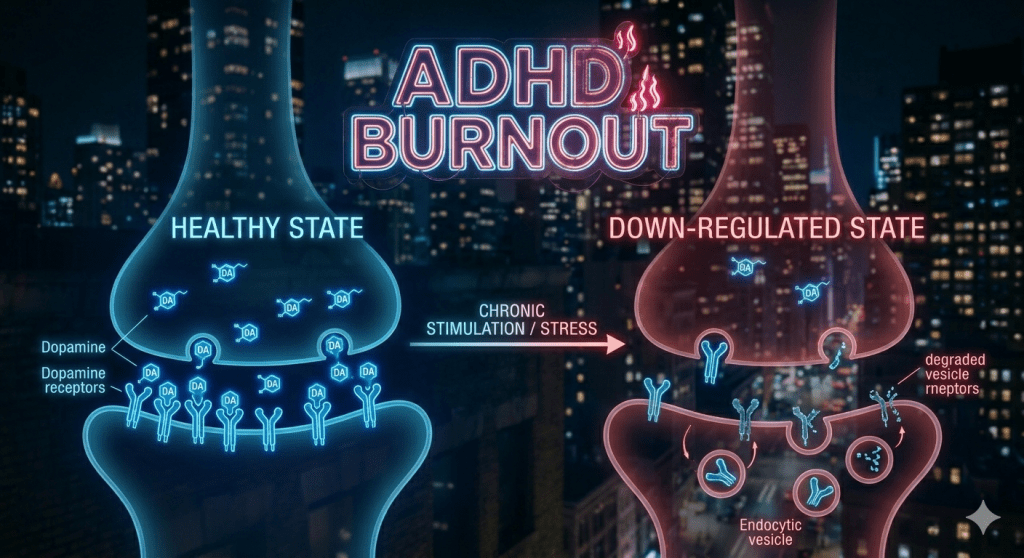
- Stress-Induced Focus (The Cortisol Loop): Many individuals with ADHD use adrenaline and cortisol to meet deadlines. While effective in the short term, chronic elevation of these stress hormones leads to Dopamine Down-Regulation.
- Dopamine Down-Regulation: To protect itself from the constant “redlining” of stress-induced dopamine spikes, the brain physically reduces the sensitivity or number of its dopamine receptors. The “ears” of the brain put on noise-canceling headphones to survive the noise, leading to a state where nothing feels rewarding or even possible.
3. Effects: When the CEO Quits
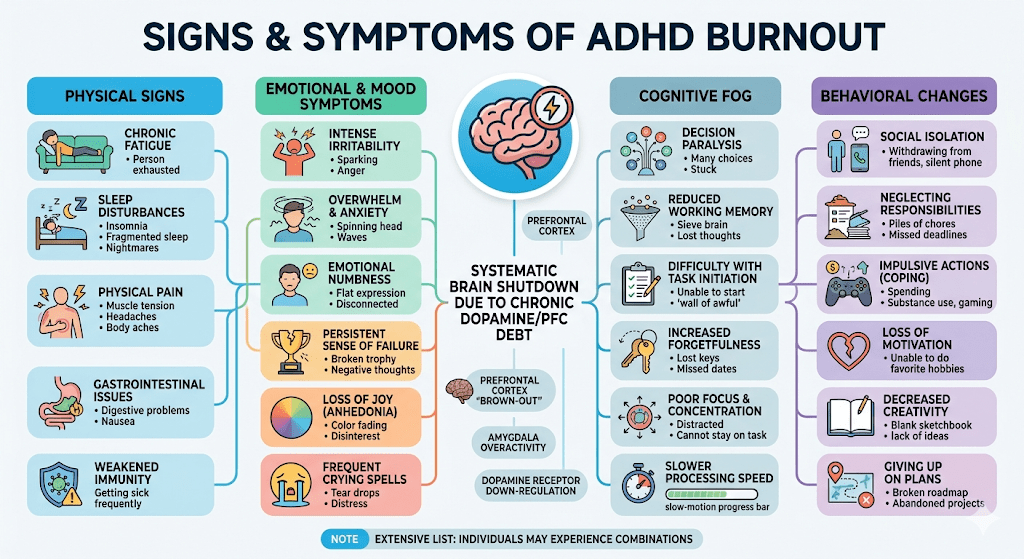
When burnout hits, the PFC essentially “goes offline.” The brain shifts from a Top-Down management style (logic and goals) to a Bottom-Up survival style (emotion and instinct).
- Executive Dysfunction: Tasks that were once manageable become insurmountable. This is not a lack of willpower; it is a Mechanical Failure of task initiation.
- Cognitive Fatigue: The “Brain Fog” becomes dense. Working memory shrinks, leading to lost items, forgotten appointments, and a total inability to process complex information.
- Sensory Hypersensitivity: Because the PFC can no longer help the Thalamus filter input, the world becomes physically painful. Sounds are louder, lights are brighter, and small irritations feel like physical assaults.
5. Summary
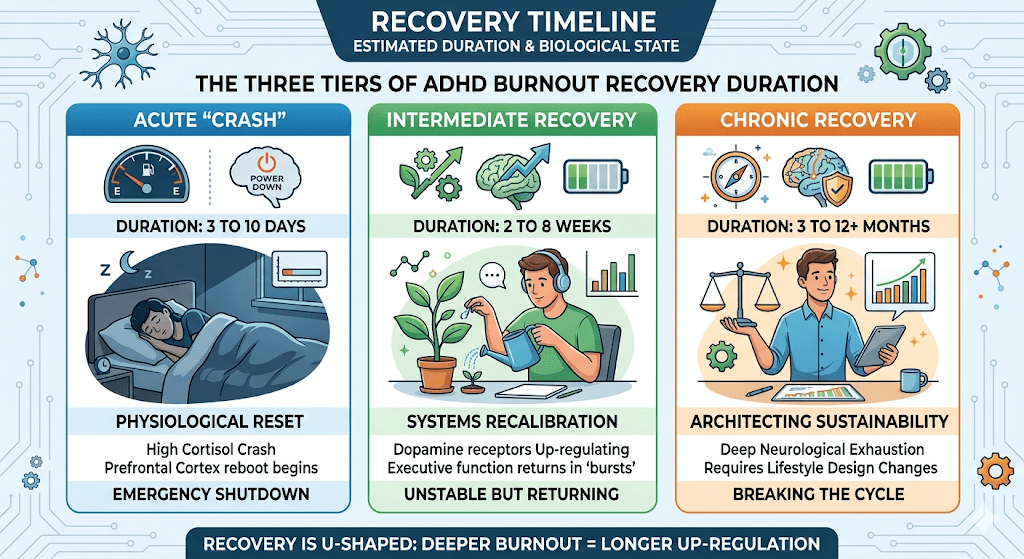
ADHD Burnout is the result of a high-performance engine being forced to run on fumes for too long. It is a protective physiological state, not a character flaw. Recovery requires more than just “rest”—it requires a complete reduction in “Executive Demand” to allow the dopamine receptors to up-regulate and the Prefrontal Cortex to reboot.