
So I’ve been in autistic burnout for several years now. Years of debilitating exhaustion that doesn’t get better with typical rest. I had to stop working full time because of it. I had to cut back my hours every year because of it. But I’m finally beginning to understand what burnout actually means (for me) and what recovery from it means. You have to reduce the amount of demands placed upon you. It could be occupational, social, sensory noise, etc. I recently saw a post by Dr. Kojo Sarfo, a neurodivergent advocate, online regarding this. He said “our nervous systems need to be left alone long enough to reset.” That really began to resonate with me and I began to consider what this means. So I did my own research on what this “reset” would mean. Here’s what I”ve discovered so far.

What does it mean for our nervous system to reset?
“Resetting” as a physiological shift from Survival Mode to Maintenance Mode. For the neurodivergent brain, this isn’t just “relaxing”-it is a literal recalibration of the body’s electrical and chemical signaling.
Here is a breakdown of what a Nervous System Reset actually entails:

A lot of people with autism, ADHD, or both, AuDHD are constantly in state of nervous system dysregulation. It’s like having the accelarator glued stuck in a car going 100 mph without brakes headed towards a brick wall. It’s fast, dangerous, and 100% real. A lot of us also have a history of trauma and very high anxiety levels with diagnoses of generalized anxiety disorder (GAD), Post-Traumatic Stress Disorder (PTSD), and Panic Disorder. I personally have every one of these.
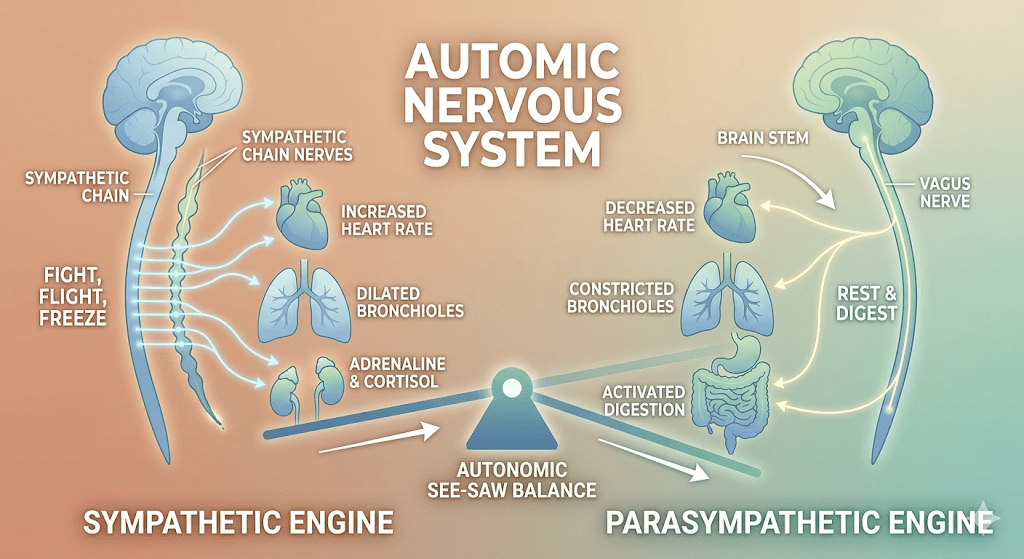
- THE SHIFT FROM SYMPATHETIC TO PARASYMPATHETIC
The human nervous system has two main gears. When we are dysregulated, we are stuck in the Sympathetic gear (Fight/Flight).
• The State: Heart rate is up, cortisol is high, and the brain is scanning for “errors” or “threats.”
• The Reset: Resetting is the act of forcing the body into the Parasympathetic gear (Rest and Digest).
• The Mechanism: This is largely controlled by the Vagus Nerve, the “superhighway” of the nervous system.
When we reset, we are sending a signal to the Vagus nerve to tell the brain that the “war” is over. This is telling our bodies that we are safe.

2. CLEARING THE NEURAL STATIC
Neurodivergent brains often have “leaky” sensory filters. We take in more data (sound, light, patterns, social cues) than we can process in real-time.
• The Overload: This creates “Neural Static”—a build-up of unprocessed sensory information that makes the brain feel “noisy” and heavy.
• The Reset: Resetting involves a sensory Fast. By removing input (solitude, silence, low light), the brain can finally stop “rendering” the outside world and start processing the backlog of data. It’s like clearing the cache on a computer that has too many tabs open.
3. RECALIBRATING THE AMYGDALA
The Amygdala is the brain’s smoke detector. In a dysregulated system, the smoke detector is screaming even when there is no fire.
• The Reset: A reset involves “Top-Down Regulation.” This is where we use repetitive, predictable actions (like stimming, rhythmic breathing, or familiar media) to prove to the Amygdala that the environment is safe.
• The Result: Once the Amygdala quiets down, blood flow returns to the Prefrontal Cortex-the part of the brain responsible for logic, planning, emotional regulation, humor, and complex thought.
4. RESTORING METABOLIC ENERGY
Processing a world that wasn’t built for your brain architecture is metabolically expensive. It burns through Glucose and Dopamine at an accelerated rate. Especially if we’re constantly stressed, dyregulated with high levels of anxiety. It’s metabolically expensive. There’s defiite cost to it all. That’s what burnout looks like. We are actually burning through our stores of energy faster than our body can reproduce it. That’s why it takes days, weeks, months, or even years to recover. I personally have been in burnout for years.
• The Reset: Resetting allows the brain to stop spending and start saving. It’s a period of Metabolic Recovery. This is why “traditional” rest (like a nap) often doesn’t work if the environment is still noisy; the brain is still “spending” energy to monitor that noise. True reset requires a total drop in demand.
5. SUMMARY: THE FACTORY SETTINGS MOMENT
A nervous system reset is essentially returning to baseline. It is the moment the body stops reacting to the past (the stressful job demands, the loud store etc.) and starts existing in the present.
In the coming days I will discuss what it means for our nervous systems to be dysregulated. See you soon!
 neurospicybrains