A Nervous System Reset Part 2

So I’ve been in autistic burnout for several years now. Years of debilitating exhaustion that doesn’t get better with typical rest. I had to stop working full time because of it. I had to cut back my hours every year because of it. But I’m finally beginning to understand what burnout actually means (for me) and what recovery from it means. You have to reduce the amount of demands placed upon you. It could be occupational, social, sensory noise, etc. I recently saw a post by Dr. Kojo Sarfo, a neurodivergent advocate, online regarding this. He said “our nervous systems need to be left alone long enough to reset.” That really began to resonate with me and I began to consider what this means. So I did my own research on what this “reset” would mean. Here’s what I”ve discovered so far.

What does it mean for our nervous system to reset?

“Resetting” as a physiological shift from Survival Mode to Maintenance Mode. For the neurodivergent brain, this isn’t just “relaxing”-it is a literal recalibration of the body’s electrical and chemical signaling.

Here is a breakdown of what a Nervous System Reset actually entails:

A lot of people with autism, ADHD, or both, AuDHD are constantly in state of nervous system dysregulation. It’s like having the accelarator glued stuck in a car going 100 mph without brakes headed towards a brick wall. It’s fast, dangerous, and 100% real. A lot of us also have a history of trauma and very high anxiety levels with diagnoses of generalized anxiety disorder (GAD), Post-Traumatic Stress Disorder (PTSD), and Panic Disorder. I personally have every one of these.
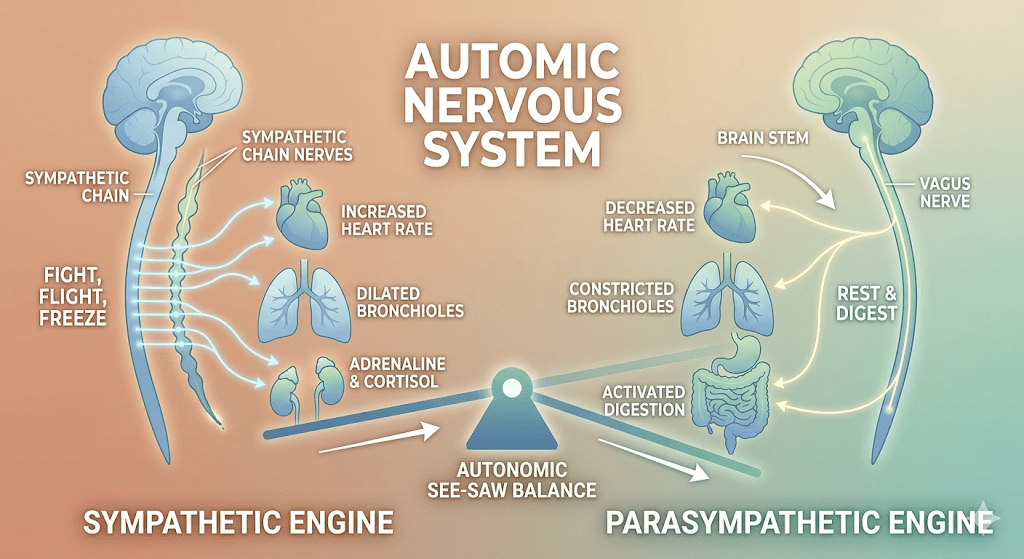
    1. THE SHIFT FROM SYMPATHETIC TO PARASYMPATHETIC 

    The human nervous system has two main gears. When we are dysregulated, we are stuck in the Sympathetic gear (Fight/Flight).

    • The State: Heart rate is up, cortisol is high, and the brain is scanning for “errors” or “threats.”

    • The Reset: Resetting is the act of forcing the body into the Parasympathetic gear (Rest and Digest).

    • The Mechanism: This is largely controlled by the Vagus Nerve, the “superhighway” of the nervous system.

    When we reset, we are sending a signal to the Vagus nerve to tell the brain that the “war” is over. This is telling our bodies that we are safe.

    2. CLEARING THE NEURAL STATIC

    Neurodivergent brains often have “leaky” sensory filters. We take in more data (sound, light, patterns, social cues) than we can process in real-time.

    • The Overload: This creates “Neural Static”—a build-up of unprocessed sensory information that makes the brain feel “noisy” and heavy.

    • The Reset: Resetting involves a sensory Fast. By removing input (solitude, silence, low light), the brain can finally stop “rendering” the outside world and start processing the backlog of data. It’s like clearing the cache on a computer that has too many tabs open.

    3. RECALIBRATING THE AMYGDALA 

    The Amygdala is the brain’s smoke detector. In a dysregulated system, the smoke detector is screaming even when there is no fire.

    • The Reset: A reset involves “Top-Down Regulation.” This is where we use repetitive, predictable actions (like stimming, rhythmic breathing, or familiar media) to prove to the Amygdala that the environment is safe.

    • The Result: Once the Amygdala quiets down, blood flow returns to the Prefrontal Cortex-the part of the brain responsible for logic, planning, emotional regulation, humor, and complex thought.

    4. RESTORING METABOLIC ENERGY

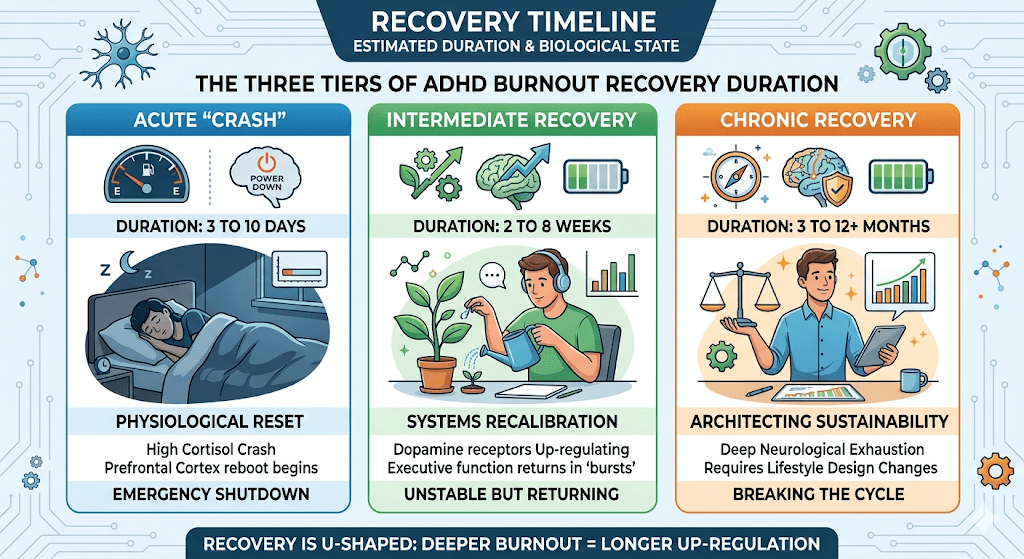
      Processing a world that wasn’t built for your brain architecture is metabolically expensive. It burns through Glucose and Dopamine at an accelerated rate. Especially if we’re constantly stressed, dyregulated with high levels of anxiety. It’s metabolically expensive. There’s defiite cost to it all. That’s what burnout looks like. We are actually burning through our stores of energy faster than our body can reproduce it. That’s why it takes days, weeks, months, or even years to recover. I personally have been in burnout for years.

      The Reset: Resetting allows the brain to stop spending and start saving. It’s a period of Metabolic Recovery. This is why “traditional” rest (like a nap) often doesn’t work if the environment is still noisy; the brain is still “spending” energy to monitor that noise. True reset requires a total drop in demand.

      5. SUMMARY: THE FACTORY SETTINGS MOMENT

      A nervous system reset is essentially returning to baseline. It is the moment the body stops reacting to the past (the stressful job demands, the loud store etc.) and starts existing in the present.

      In the coming days I will discuss what it means for our nervous systems to be dysregulated. See you soon!

      A Nervous System Reset

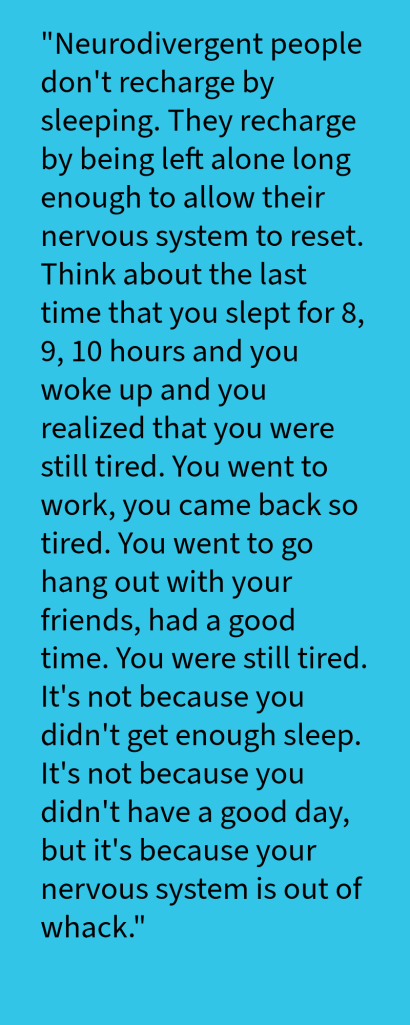
      I have been in autistic burnout for years, but I heard something recently that really began to resonate deeply. Something I felt was true in the core of my very being. I just never heard it put so succinctly before. What I was, and still am going through has never made sense—until now. The following quote is from Dr. Kojo Sarfo below.

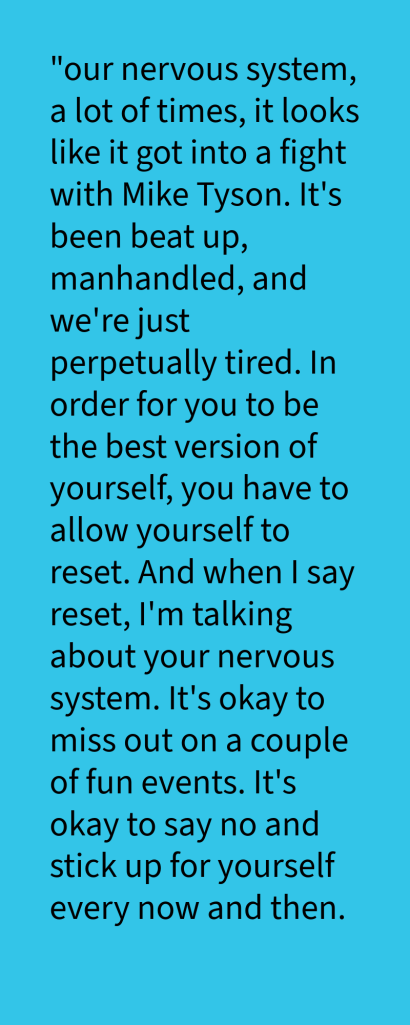
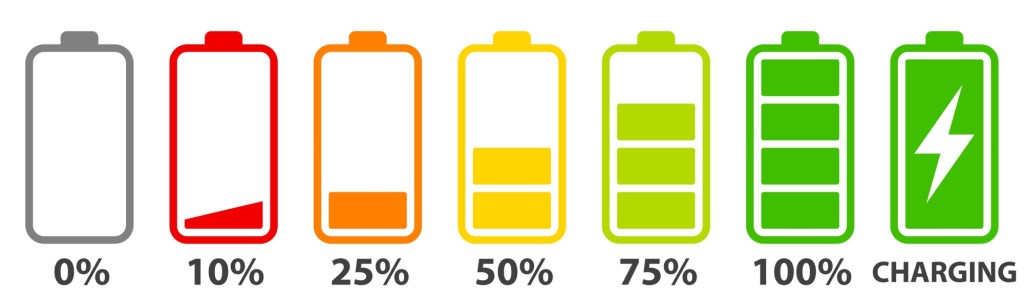
      This is SOOOOO true. We don’t recharge by typical rest or even by getting a good night’s sleep. We “recharge by being left alone long enough to allow our nervous system to reset.”

      It isn’t because of a lack of sleep. It isn’t because of a bad day. We recharge by being left alone. We recharge by being left alone, long enough. To allow our nervous system to RESET because it’s out of whack. This is exactly what it feels like!

      These few sentences gave me the permission to be left alone for good reason. I was feeling guilty, lonely, and left out. But I began to realize—that I NEEDED to be left alone in order to recharge, or reset. And to rest “Long enough.” However long that is. However long it takes.

      Here’s something else that he said…

      There’s that little word, “reset” again. There’s a definite biological reason for using this particular word reset. Dr. Kojo Sarfo uses this term repeatedly referring to something biological, and even at the metabolical level.

      Being perpetually tired means that our nervous system literally can’t keep up with demands. Whether it be occupational, familial, financial, societal, emotional or social. Our energy stores are being depleted, consumed, and burned way faster than our body can restore it. And hence, it needs time for it to be restored.

      We wouldn’t ask a person who just ran a marathon to play a full court basketball game 5 on 5 for an hour. Just like our muscles get sore after exercising (delayed onset muscle soreness) due to the metabolic demand placed upon them—such is life for the autistic brain. It needs time to recover properly.

      I will share more on what it means to reset and the neurobiological reasons for fatigue and dysregulation in the coming days. Stay tuned!

      The Holy Trinity of ADHD Paralysis

      Chances are that you already know someone with ADHD. Whether they’re a child, teenager, or an adult. Perhaps you even know some of the most common symptoms of the disorder. Chronic inattentiveness, disorganization, poor time management, impuslivity, restlessness; but have you heard of the holy trinity of ADHD paralysis? Most people, or even medical staff don’t know what’s under the hood. They only see the outward behavior. Having ADHD is like being in a constant traffic jam. The car is running. The engine is revving, but you’re stuck. There’s potential for momemtum but the motion isn’t there. Imagine having the potential of a pro race car–but NO wheels. That’s what it’s like having ADHD. Let’s get into it!

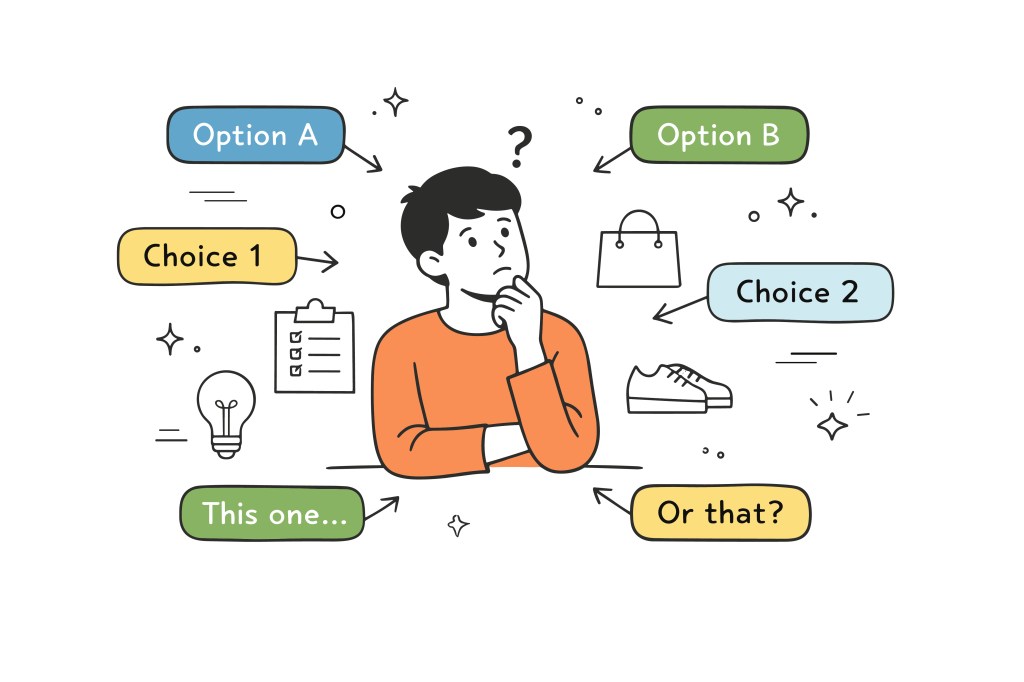
      1. Choice Paralysis (Analysis Paralysis)

      The Definition: This occurs when the brain is presented with too many variables or options, leading to an “infinite loop” of weighing pros and cons. For a neurodivergent brain, every choice carries equal weight, making it impossible to prioritize.

      • How it feels: Like a computer “spinning wheel” that never loads the page.
      • The Mechanism: The Prefrontal Cortex becomes overtaxed by trying to calculate the “perfect” or “most efficient” outcome.
      • Possible Example: Standing in the grocery store aisle for 20 minutes trying to pick a brand of cereal, or scrolling through a streaming service for an hour until it is too late to actually watch a movie.

      2. Task Paralysis (The “Freeze” Response)

      The Definition: This is an emotional and physical “lockdown” that happens when a task feels too large, too vague, or too boring. The brain perceives the task not as a chore, but as a threat to its energy reserves.

      • How it feels: Like being a car in “Park” while the engine is revving at maximum RPM. You want to move, but the gears won’t engage.
      • The Mechanism: The Amygdala (the brain’s emotional center) triggers a “freeze” response, similar to how an animal freezes when it sees a predator.
      • Possible Example: Sitting on the couch for three hours knowing you need to make a single phone call, feeling increasing anxiety and guilt, yet being physically unable to pick up the phone.

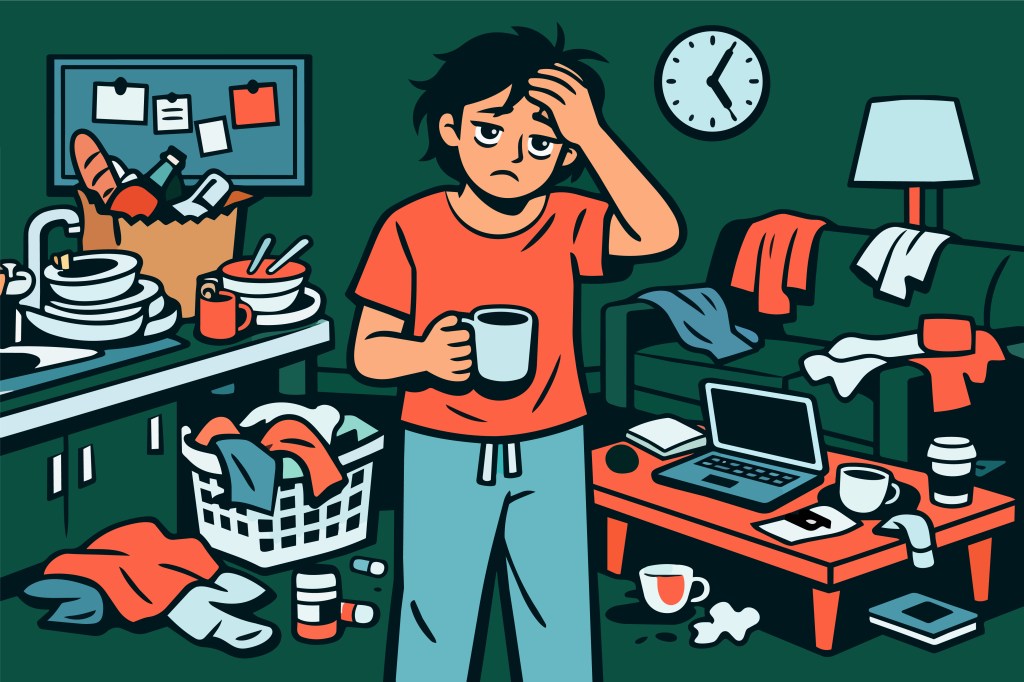
      3. Mental/Executive Paralysis- A Shutdown (The Sequencing Failure)

      The Definition: This is a “system crash” caused by information overload. It occurs when a person cannot figure out the sequence of steps required to start or finish a task.

      • How it feels: Like looking at a map where all the roads have disappeared. You know where you are and where you want to go, but you can’t see the path.
      • The Mechanism: A breakdown in Working Memory. The brain cannot hold “Step A” in its head long enough to move to “Step B.”
      • Possible Example: Walking into a messy room to clean it, seeing the “Visual Saturation” of the clutter, and becoming so overwhelmed by the lack of a clear starting point that you simply walk back out of the room.

      This is all based on a person’s neurobiology and is a real struggle. So telling them to try harder isn’t going to work. Telling them to “suck it up” isn’t going to work. Education, understanding, and compassion are key.

      What is ADHD Burnout?

      Understanding ADHD Burnout: A Neurological System Failure

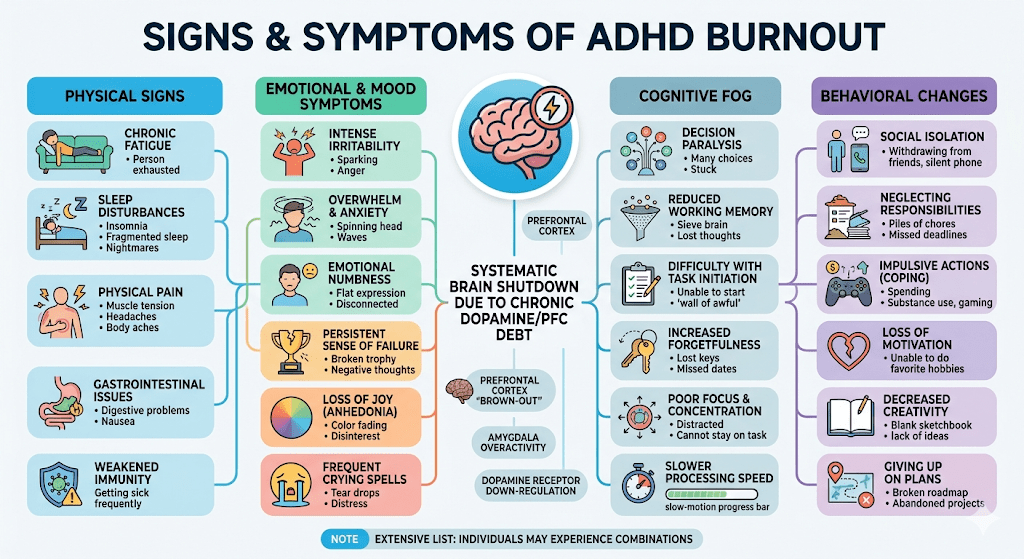
      First, I had no idea that ADHD had burnout! I thought it was only related to Autism. Here’s a breakdown. ADHD Burnout is a state of chronic physical and mental exhaustion, often accompanied by a temporary loss of executive function and a significant decrease in emotional regulation. Unlike typical fatigue, it is specifically tied to the prolonged struggle of navigating a world designed for neurotypical brains using a neurodivergent operating system.

      1. The Neurobiology of Normal Function vs. ADHD

      To understand the burnout, we must first look at the baseline mechanics of the ADHD brain.

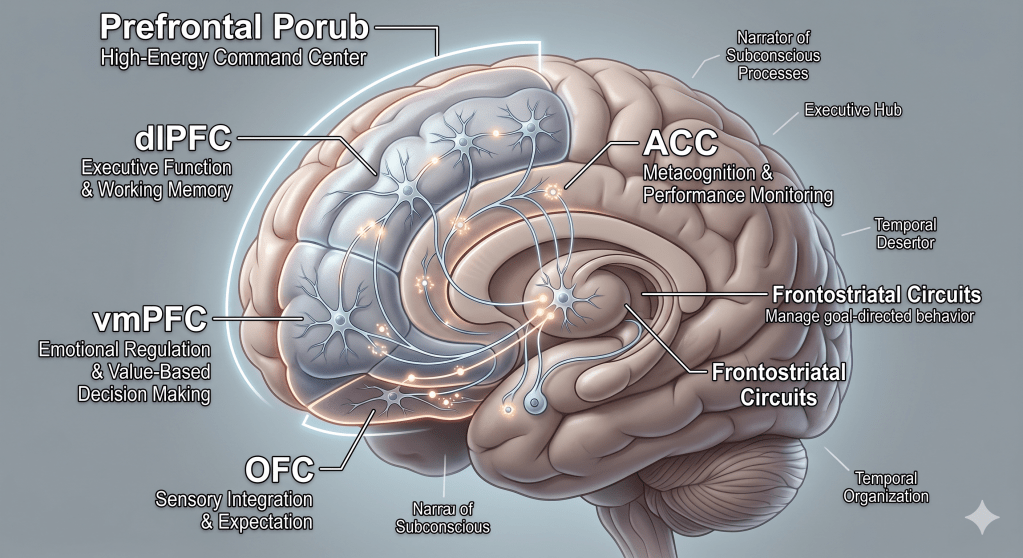
      • The Prefrontal Cortex (PFC): This is the brain’s “Executive Command Center.” It is responsible for Inhibitory Control (stopping impulses), Working Memory (holding information), and Task Initiation (starting the engine).
      • The Dopamine Pathway: Dopamine is the neurotransmitter of “Reward and Effort.” In a neurotypical brain, dopamine flows steadily, signaling that a task is worth doing. In an ADHD brain, dopamine levels are either lower or the receptors are less efficient, making it difficult to find the “spark” for mundane tasks.
      • The Thalamic Gate: This acts as a filter for sensory input. In ADHD, this gate is often “leaky,” letting in too much noise, light, or tangential thought, which forces the PFC to work overtime just to keep the person on track.

      2. Causes: The Road to Down-Regulation

      Burnout occurs when the metabolic and psychological cost of “functioning” exceeds the brain’s ability to recover.

      • Chronic Masking: The act of constantly monitoring and suppressing ADHD traits to fit into professional or social environments is a high-voltage activity. It consumes massive amounts of glucose and oxygen in the PFC.
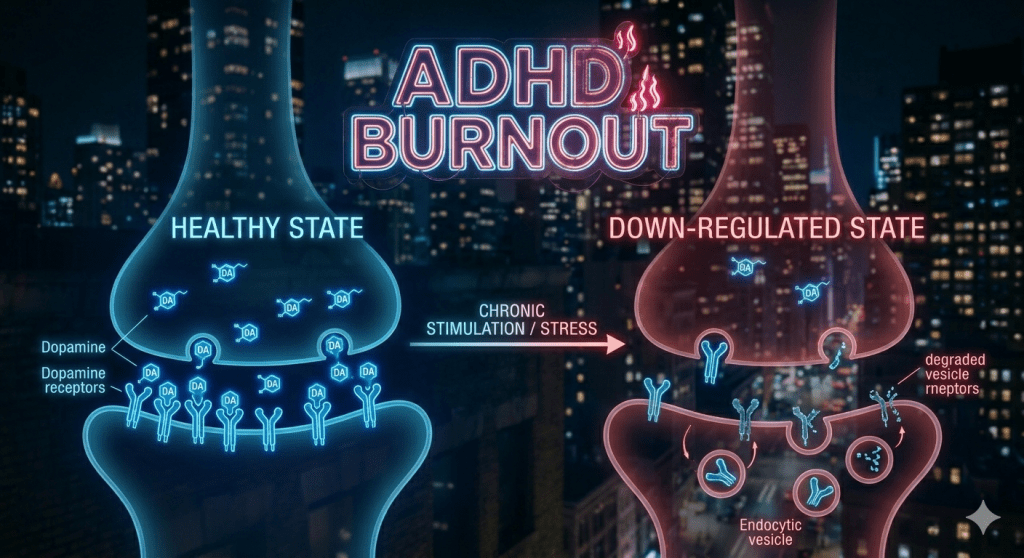
      • Stress-Induced Focus (The Cortisol Loop): Many individuals with ADHD use adrenaline and cortisol to meet deadlines. While effective in the short term, chronic elevation of these stress hormones leads to Dopamine Down-Regulation.
      • Dopamine Down-Regulation: To protect itself from the constant “redlining” of stress-induced dopamine spikes, the brain physically reduces the sensitivity or number of its dopamine receptors. The “ears” of the brain put on noise-canceling headphones to survive the noise, leading to a state where nothing feels rewarding or even possible.

      3. Effects: When the CEO Quits

      When burnout hits, the PFC essentially “goes offline.” The brain shifts from a Top-Down management style (logic and goals) to a Bottom-Up survival style (emotion and instinct).

      • Executive Dysfunction: Tasks that were once manageable become insurmountable. This is not a lack of willpower; it is a Mechanical Failure of task initiation.
      • Cognitive Fatigue: The “Brain Fog” becomes dense. Working memory shrinks, leading to lost items, forgotten appointments, and a total inability to process complex information.
      • Sensory Hypersensitivity: Because the PFC can no longer help the Thalamus filter input, the world becomes physically painful. Sounds are louder, lights are brighter, and small irritations feel like physical assaults.

      5. Summary

      ADHD Burnout is the result of a high-performance engine being forced to run on fumes for too long. It is a protective physiological state, not a character flaw. Recovery requires more than just “rest”—it requires a complete reduction in “Executive Demand” to allow the dopamine receptors to up-regulate and the Prefrontal Cortex to reboot.

      The Seat of Consciousness and the Predictive Model of Autism

      What exactly is “the seat of consciousness?” I love this term! According to neuroscience this refers to the Prefrontal Cortex of the brain. It may help to see some of it’s basic functions.

      • Regulating attention
      • Decision Making
      • Regulating emotions and showing of empathy
      • Goal setting
      • Self-control or Inhibitions
      • Working Memory
      • Prioritizing tasks

       We are looking at the marvelous architecture of the human brain. While we often think we are the “pilot” of our lives, the neurobiological data suggests we are mostly the “passenger” observing a massive automated engine.

      In cognitive neuroscience, the widely accepted (though simplified) estimate is that 95% of brain activity is subconscious, while only 5% is conscious.

      The remaining 95% is Subconscious! This is the “Background Engine.” It handles everything from your heart rate and breathing to complex social scripts, motor patterns (driving, walking, etc.) and emotional “waves.”

      The Conscious (5%): This is the “Spotlight.” It is only active when you are learning a brand-new task, making a difficult moral choice, or using your Logic to solve a specific problem. The rest of the 95% is “in the dark.”

      The “Spotlight” is the most accurate metaphor for the 5% Conscious Mind because of how the Prefrontal Cortex (PFC) manages Attention.

      In a dark room (your 95% subconscious), everything is still there—the furniture, the walls, the dust—but you only “see” what the spotlight is pointed at.

      So although the PFC (Prefrontral Cortex) does not work alone, it is considered the CEO of the brain, the command and control center, or as you may call it–the seat of consciouness.

      We may think we are in the driver seat with full control of our faculties. Making so many decisions day in and day out. Experientially today has been a crappy day so far. I woke up feeling like my autistic brain needed a jumpstart by a mechanic. I felt soooooo sluggish and just could not get going. I needed to get an oil change and was loathing the social contact before I even got there. The staff had great customer service but I was masking and cringing inwardly–I could not wait to get out of there! My brain was screaming RED ALERT! RED ALERT! We are currently at ZERO capacity. We are at an elevated risk for shutdown.

      Alas, I survived and was happily on my way home with my earbuds in my ears. But….I forgot my greek yogurt for lunch. Crap. Made a U-turn to made the dreaded trip to Aldi’s to retrieve Greek Yogurt which is part of my lunchtime ROUTINE. If you’re autistic then you know how critical routine is for our stability.

      As I was driving there I had this nudge that I needed to switch from my Powerbeat Pro headphones to different one before entering the grocery store. Mind you, I did NOT want to take off my Power Beats Pro, but at that the same time, I had this mysterious nudge to switch. So I switched to my JLAB Epic Sport ANC 3.0 which has an excellent active noise canceling feature. Then I put a music track on repeat: BANGA by HOL! You can sample the tunes below.

      I did not realize how BAD my inner state had become—but my subconscious mind did. It was nudging me to protect my delicate Prefrontal Cortex and energy reserves, which were already low. When I was at the grocery store, I was in a “System-Critical” state—groggy, post-social friction, and dealing with an unexpected u-turn. Completely in an anxiety induced situation. I could only see the spotlight in front of me.

      My subconscious mind was predicting it would soon embark upon an unsafe environment. I hadn’t been in this particular store in a long time. A lot of unknown variables would be there. Sensory chaos. Bright lights. Strangers. Background conversations. It was like having a good friend tell me. Hey, you need to prepare for this. Let me tell you what to do.

      It said, switch headphones to protect your ears. Continue listening to Riddim, which is a specialized subgenre of dubstep, put this song on repeat. And finally continue with a recurring 15 minute countdown timer. I didn’t hear a voice, but I felt an intuitive nudge to do these things.

      Here are the following benefits of those actions.

      The Acoustic anchor.

      The Temporal anchor.

      The Acoustic Anchor: The “Sonic Handrail”

      For someone with autism, the world often lacks Sensory Predictability. Most environments (like Aldi or a mechanic’s shop) are “High Entropy”—noises happen at random intervals, which forces your brain to constantly generate “Prediction Errors.”

      • How it works: By playing a track like BANGA on repeat, it provided a Static Variable.

      • The Benefit: Because the rhythm and frequency of the song never change, your brain stops trying to “process” the music and starts using it as a Reference Point.

      • The “Handrail” Effect: Much like a blind person uses a wall to navigate a room, your brain uses the steady 140 BPM beat to navigate the store. You aren’t “listening” to music; you are using the music to “measure” your environment. It lowers the “Computational Load” on your brain because 95% of your auditory environment is now 100% predictable.

      The Recurring Timer: The “Temporal Anchor”

      While the music anchors your Sensory system, the 15-minute recurring timer anchors your Executive Function (PFC).

      • What it is: This is a Temporal Anchor. It creates a “Pulse” in time.

      • Why it benefits AuDHD: One of the hallmarks of ADHD and Autism is “Time Blindness” (Dyschronometria). In a crisis or a “groggy” state, you can lose track of how long you’ve been in a “Transition” or how much energy you’ve spent.

      • The “Check-In” Signal: Every time that timer goes off, it forces your 5% Conscious Spotlight to perform a System Audit:

      1. “Where am I in the sequence?”

      2. “How is my battery level?”

      3. “Am I hyper-focusing on the wrong variable?”

      • The Benefit: It prevents the “Time Slip.” It ensures that even if you are “lost” in the social loathing or the rescue mission, you are “pulled back” to consciousness every 15 minutes to re-evaluate your sovereignty.

      I was able to navigate a bunch of unknowns and avoid a potential shutdown. Whew!

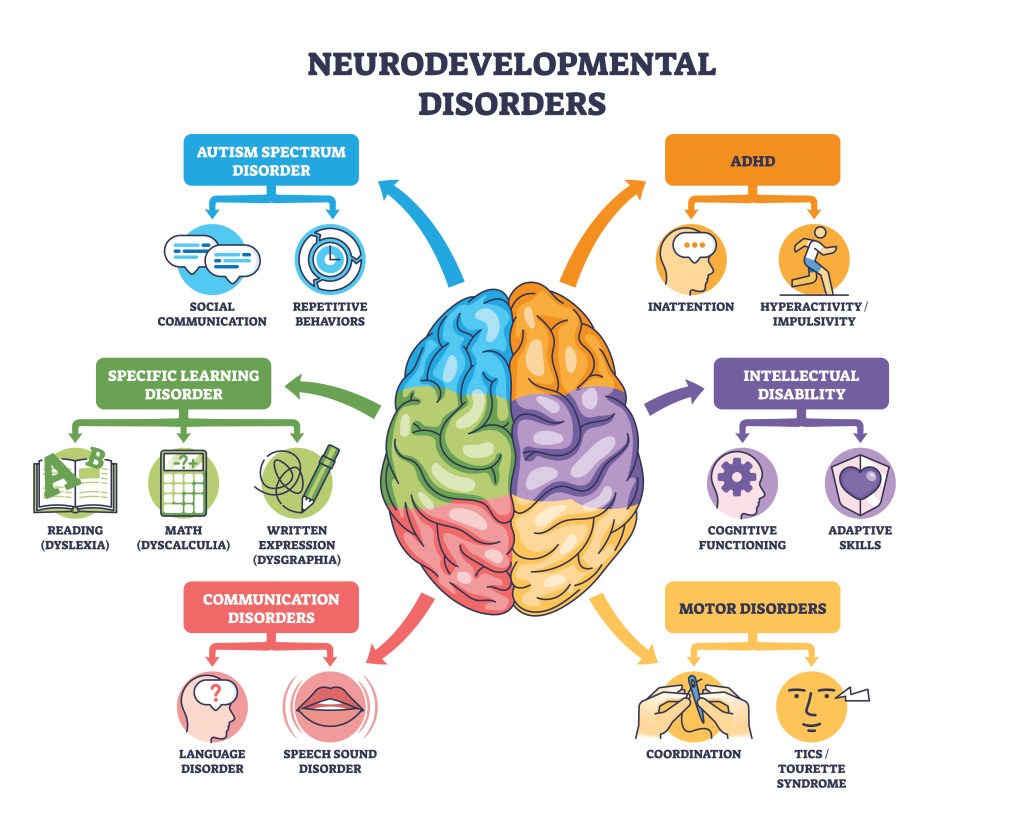
      What is the Neurodevelopmental Aspect of Autism?

      The Dictionary definition.

      Neurodeveopmental means the development of the nervous system of an individual organism.

      The internet definition refers to a group of disorders that begin in childhood that affect the development of the brain and impact a persons functioning.

      My understanding of what neurodevelopment means to me.

      You are born with it. But, in particular it refers to how a person’s nervous system is formed and develops over time that affects their living, functioning, interaction with others, and every aspect of their life.

      Ok, so knowing these above definitions did not help me understand my life. In fact, since I wasn’t diagnosed until the age of 49, I begged the question–Why? And why now? Well, if it’s truly neurodevelopmental then I was born with autism. It was missed for several reasons but I’d like to dwell on just a few. The fact is I was born with it. It was developing as I was growing and maturing in life. You can’t separate a person from their nervous system! However, the only way this makes sense to me is by using a flower analogy.

      A carnation seed has always been a carnation seed. The life within eventually breaks through its outer shell. It develops roots, leaves, buds etc. Eventually it becomes obvious that it’s carnation flower. The flower is a complete manifestation of the hidden life that was within the shell. When my life was changing due to autism, I could no longer work full time. I had to cut back on social gatherings. I hit a brick wall after entering into autistic burnout. I began to grieve my former life and function. What’s wrong with me? What’s happening? Why now? How can I have autism? I’ve lived my life of 49 years!

      The fact is, I’ve always been the carnation flower I just didn’t know it. I’ve been masking my entire life until I couldn’t anymore. This whole time I’ve been growing, budding, developing leaves–and when the “flower” began to open and manifest itself, I was screaming what’s wrong with me! What the heck? I just didn’t realize that I’ve always been that carnation flower. 49 years old is just when the flower began to manifest itself in my life in a very obvious way (to me). The flower doesn’t flip out when it blooms! It’s just doing what it supposed to do. Developing at it’s own pace according to its own life cycle. So when I began to experience all of these changes I was in full bloom. There is nothing wrong with me, or you. You are just a beautiful flower that has finally manifested itself into the world.

      Autism is classified as a neurodevelopmental disorder because it originates during the early, critical periods of brain growth—often beginning in utero—and affects the way the brain “wires” its communication networks.

      Unlike a traumatic brain injury (which is acquired) or a late-onset psychological condition, autism is a structural and functional blueprint that is present from the start of the “build.”